Sofia's Low-Emission Zone Returns in 62 Days. What Will Every Detour Cost?
On 1 December, Sofia's winter low-emission zone is due to return under the current municipal ordinance. For a small delivery company, the important letters are N1. They cover goods vehicles with a technically permissible maximum mass up to 3.5 tonnes, including many delivery vans.
A restricted van that reaches the zone without a checked plan can create a last-minute reassignment, a boundary detour or a failed stop. Each extra kilometre has a direct cost. At the latest Bulgarian diesel average and 10 litres per 100 kilometres, that cost is €0.19156 in fuel.
Which delivery vehicles enter the decision
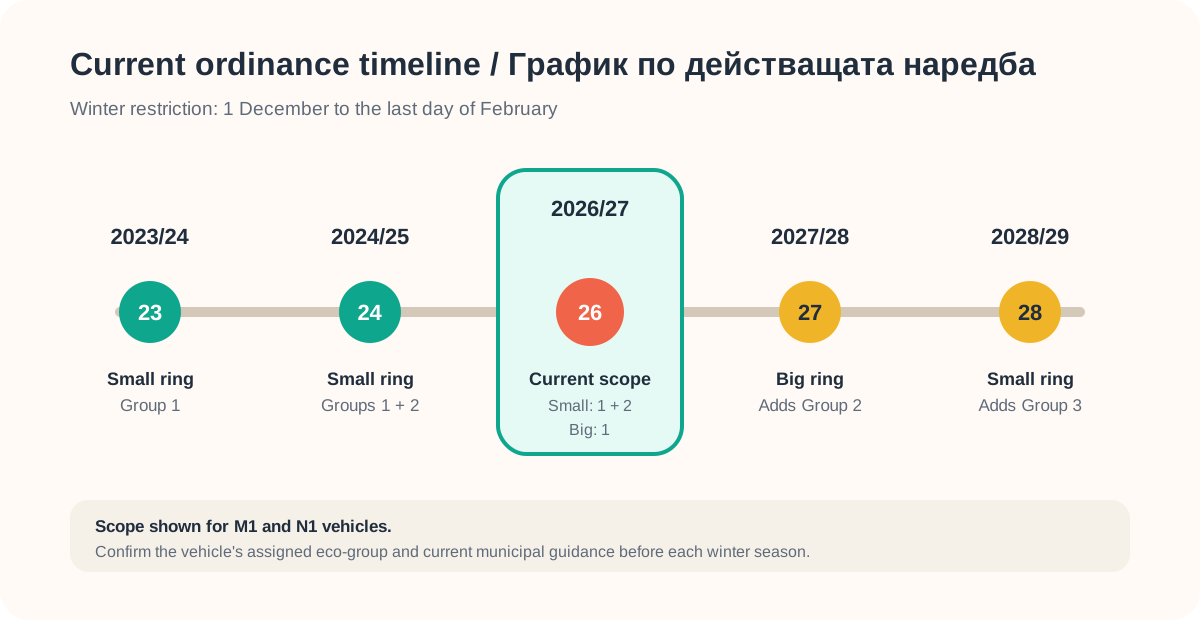
The official schedule covers vehicle categories M1 and N1. Under the current ordinance, the winter 2026/27 scope is:
| Zone | Restricted eco-groups | Winter period |
|---|---|---|
| Small ring | Groups 1 and 2 | 1 Dec 2026 to 28 Feb 2027 |
| Big ring | Group 1 | 1 Dec 2026 to 28 Feb 2027 |
The eco-group is assigned during the vehicle's annual technical inspection and shown on its inspection record or sticker. Registration year and Euro class can help with an initial check, while the assigned group and the municipality's checker should control the operational list.
Sofia Municipality's 2025 reminder also states that the boulevards forming the boundaries are outside the low-emission zone and remain available to all vehicles. That detail can preserve a route corridor, provided the vehicle does not enter the restricted area.
Compliance changed quickly when the zone expanded
These are municipal compliance measures. They show that drivers changed behaviour as the rules became familiar. They do not measure a company's route cost or its savings.
Every unplanned detour reaches the fuel bill
The European Commission's bulletin published on 24 September reports Bulgarian automotive diesel at €1.9156 per litre for 21 September 2026. For a van using 10 l/100 km:
direct fuel cost per km = €1.9156 × 10 ÷ 100 = €0.19156
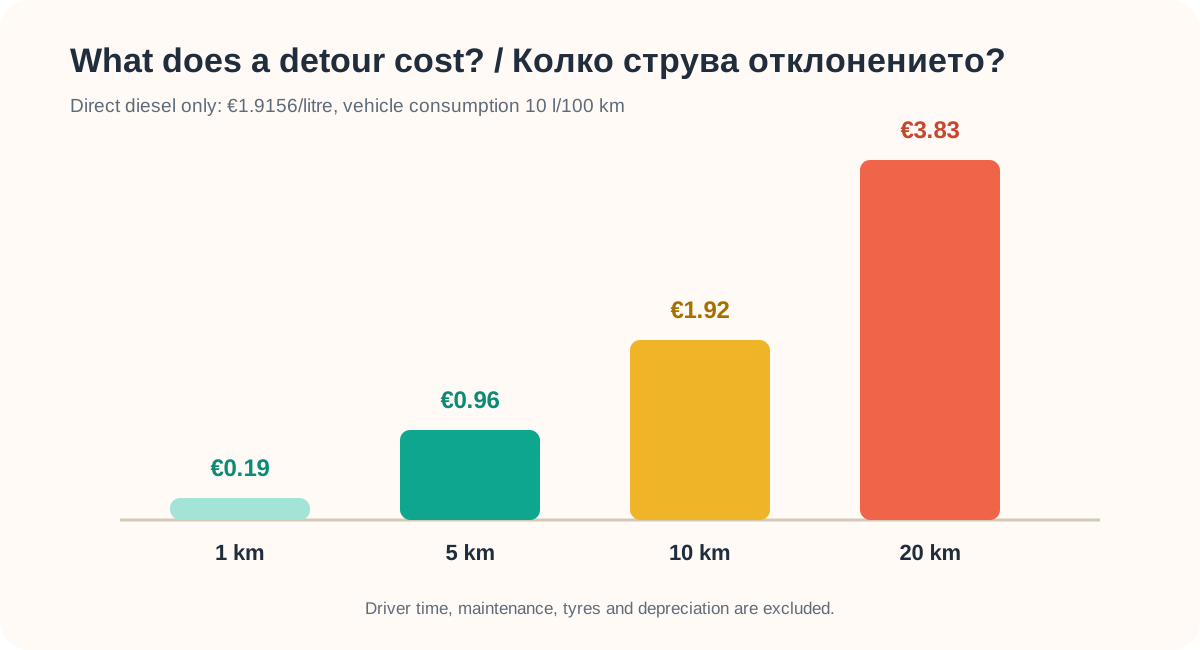
Five added kilometres cost about €0.96 in diesel. Ten cost €1.92. Twenty cost €3.83. Multiply the distance by the number of routes that repeat it, then add paid driver time and the company's variable vehicle cost per kilometre.
Three route checks before 1 December
- Build a fleet eligibility table. Record registration number, category, assigned eco-group, inspection expiry and any confirmed exemption. Recheck the official municipal tool when a record changes.
- Mark affected stops. Identify addresses inside each ring, on the boundary and outside it. Verify loading access and time windows alongside the zone status.
- Reallocate compatible work. Group nearby inside-zone stops on an eligible vehicle when capacity, working time and service commitments allow. Keep restricted vehicles on productive corridors outside the zone.
Consider six compatible central deliveries currently spread across three routes. If one eligible vehicle can complete the group and the revised plan removes two repeated approaches totalling 12 km, the verified direct fuel saving is €2.30 that day. Across 22 comparable delivery days, the same measured change equals €50.57 in diesel.
The example assumes that all six deliveries were already scheduled, remain successfully completed and 12 km truly disappear from the full plan. Traffic, capacity, time windows, driver hours and the return to base can change the result.
Measure the whole plan before the vans leave
A legal detour can still be a costly route. A compact reassignment can reduce repeated approaches while preserving every delivery. Track four numbers for each comparable day:
- total planned kilometres;
- completed deliveries per route;
- kilometres per completed delivery;
- zone-related added kilometres and reassignments.
MileCut supports the planning part of this process. Upload the day's stops, review vehicle allocation and stop order, then share routes through Google Maps. Keep the eligibility table beside the plan because MileCut does not certify a vehicle's eco-group or legal access.
Compare the complete manual plan with the revised plan for the same deliveries. Every verified kilometre removed is €0.19156 in direct fuel under the current example inputs. A denser route also spreads the approach distance and driver time across more completed stops.
Sources and limits: Sofia Municipality official transport-zone leaflet, low-emission-zone information, boundary-road and exemption reminder, reported 2025/26 compliance results, European Commission Weekly Oil Bulletin. The cost examples use a national average, 10 l/100 km and rounded euro amounts. Station prices and actual consumption vary. This operational guide is not legal advice and makes no fixed savings promise.
Plan the eligible vehicle before 1 December.
Group the scheduled stops, compare total kilometres and brief each driver before dispatch.