
Bulgaria illustrates why businesses should track both the price of a litre and the speed of change.
The European Commission's 14 September 2026 comparison placed average petrol at €1.620 per litre and diesel at €1.856. Among the eight CEE countries used in this series, Bulgarian petrol was the lowest and diesel was almost level with Slovenia at the bottom of the group.
Eurostat's August annual-change measure recorded another dimension. Bulgarian fuels and lubricants for personal transport were 34.5% more expensive than in August 2025. This was the largest annual increase in the EU. Bulgarian diesel also rose 13.5% between July and August, the second-largest monthly increase reported by Eurostat.
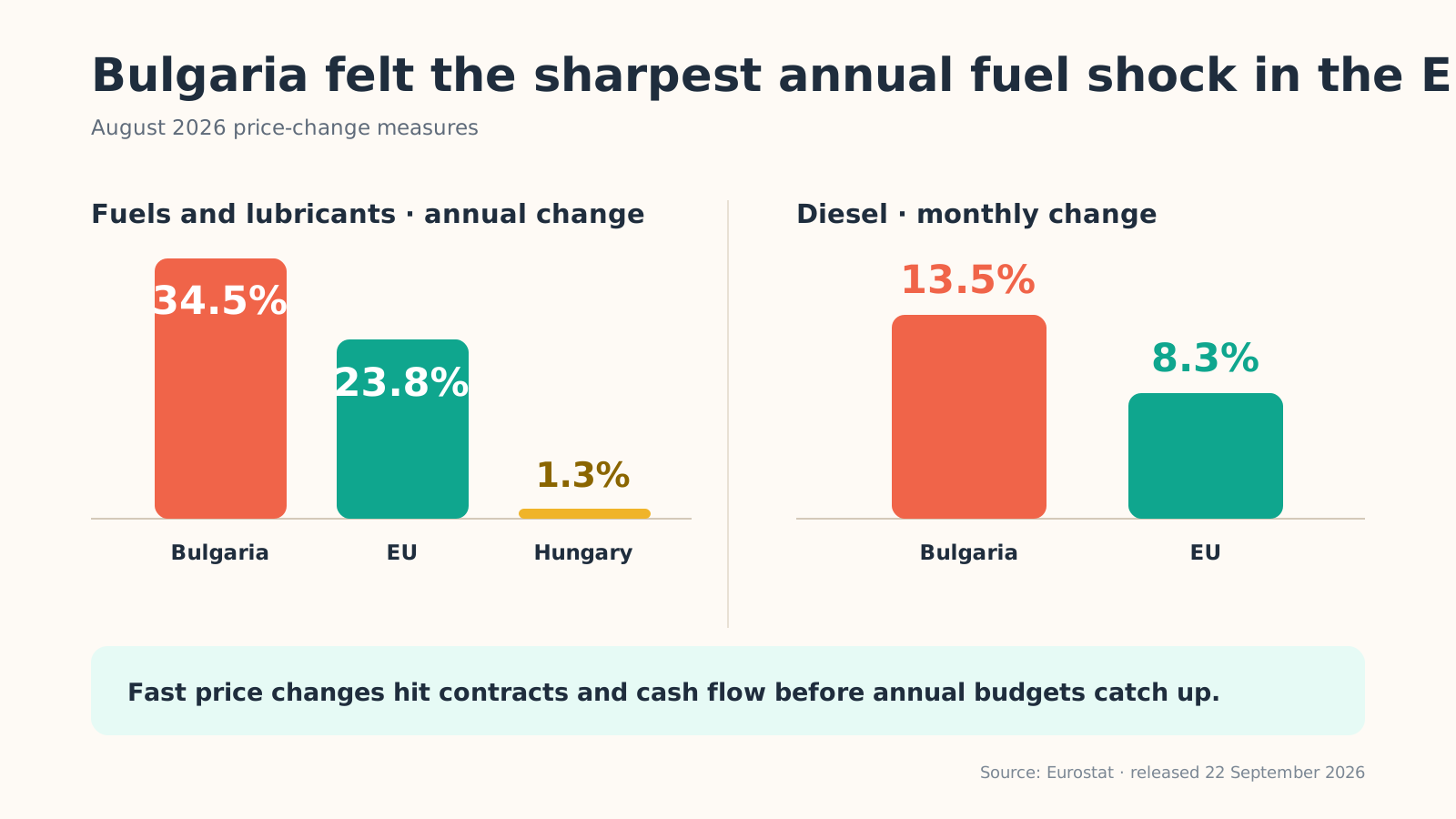
The figures describe different dimensions of the market. A price can start from a lower base, remain lower than neighbours, and rise quickly relative to the previous year.
The price history shows when the cost base changed
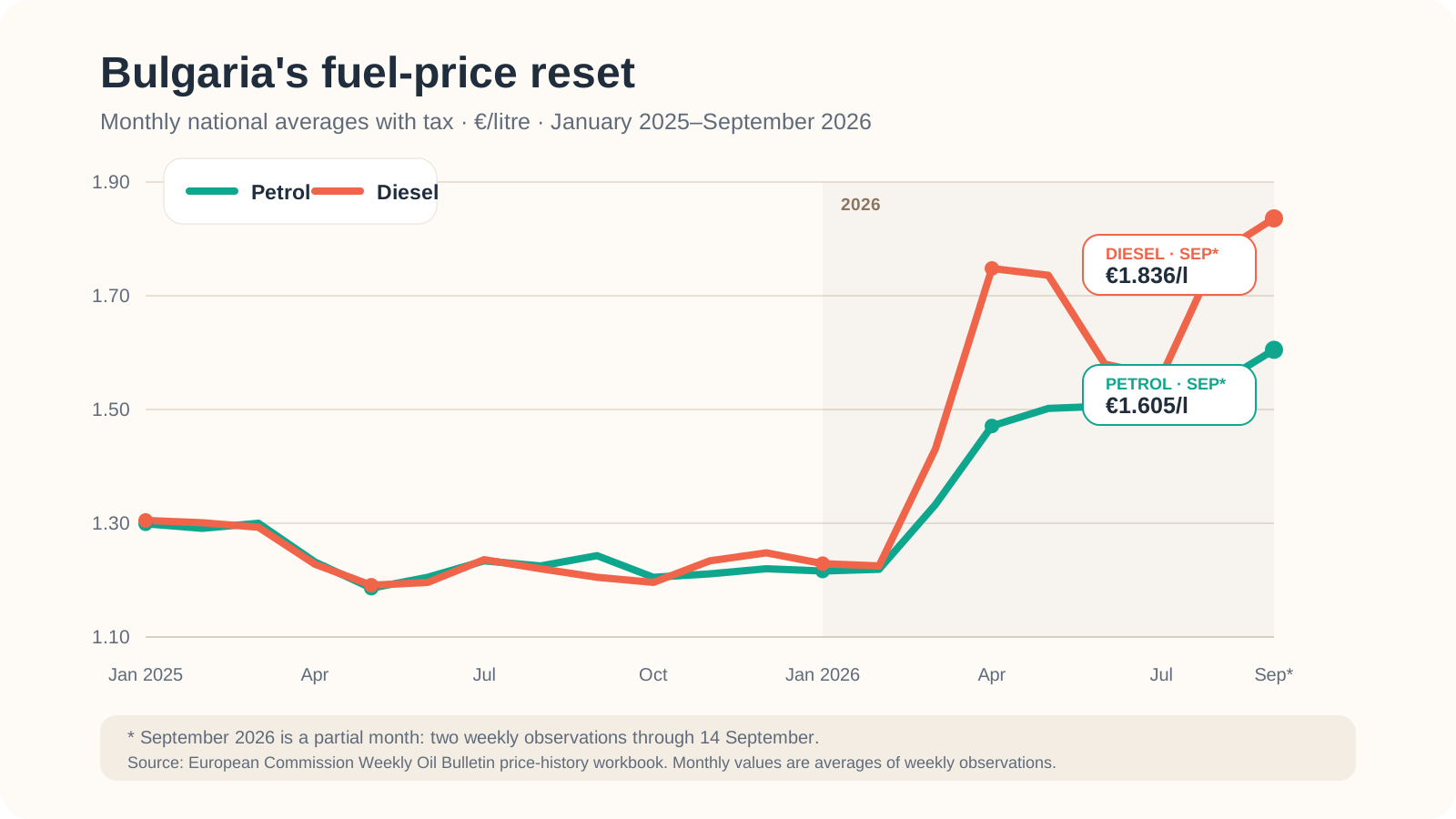
The Commission's weekly history shows Bulgarian diesel averaging €1.305 per litre in January 2025 and €1.836 in September 2026. The September figure is a partial-month average of the two observations through 14 September. Across those two points, diesel increased by €0.531 per litre, or 40.7%.
For a van using 10 litres per 100 kilometres, the fuel cost rose from €0.1305 to €0.1836 per kilometre. The same 1,000 monthly kilometres therefore carry €53.10 more fuel cost than they did at the January 2025 average. This is the economic effect an owner can place directly into route and customer margins.
Why Bulgaria is exposed
Bulgarian National Bank research highlights three structural points. In 2024, oil products represented 9.7% of Bulgaria's goods imports. The economy is relatively energy intensive. Energy had a 10.8% weight in the 2025 consumer basket used in the bank's analysis.
The BNB simulated a permanent oil-price shock 10% above its baseline. The model estimated Bulgarian HICP inflation would be 0.09 to 0.14 percentage points higher over 2025–2027, with a small negative first-year effect on real GDP growth. This model scenario illustrates the direction and persistence of an oil shock's transmission through the economy.
National Statistical Institute data adds an operational view. Oil and petroleum products supplied 93.27% of Bulgarian road-transport energy consumption in 2024. Cars and vans accounted for 65.10% of road-transport energy use. Fuel volatility therefore reaches far beyond large hauliers; it matters to service vans, local wholesalers, tradespeople and small delivery teams.
The Bulgarian price is also a market-structure story
The Commission on Protection of Competition has been examining the fuel chain, including production and import, storage, wholesale and retail. In May 2026 it proposed measures including a weekly official fuel index, more transparent data on prices and margins, supply-continuity planning, diversified crude supply and reforms around tax-warehouse access.
These policy proposals and competition proceedings show which domestic links the authority considers important: wholesale access, storage, imports, competitive conditions and transparency. Establishing responsibility requires the authority's completed findings.
What a Bulgarian small business should monitor
A useful weekly dashboard needs only six lines:
- average litres purchased and effective €/litre;
- kilometres driven;
- litres per 100 kilometres by vehicle;
- paid driver-hours;
- completed and failed stops;
- gross margin after direct delivery cost.
The company should also keep two external reference points: the Commission's weekly Bulgarian petrol and diesel prices and Eurostat's monthly fuel index. The first helps assess the current level. The second shows the direction and pace of change.
Add three operating measures to that view: completed deliveries per route, kilometres per completed delivery and fuel cost per completed delivery. When the external price rises, these measures reveal whether route planning is containing the impact or allowing excessive kilometres to magnify it.
Separate external causes from operational control
A small company controls its routes, dispatch decisions and pricing response. It can decide whether five vans cross the same district twice, whether a low-density delivery goes out today, whether a failed address creates a second trip, and whether price changes are reflected in quotes before margin disappears. Shipping routes, excise duty and wholesale-market structure remain external factors.
That is where fuel economics becomes operating discipline.
MileCut supports the part the owner can change. It groups the day's stops into routes, assigns them across vehicles and proposes a stop sequence for review. More compatible deliveries on one route can reduce repeated journeys through the same area. Comparing the resulting planned kilometres with the normal plan shows the direct fuel saving before dispatch and explains why route planning becomes more valuable during a Bulgarian price shock.
Sources: Eurostat: fuel-price change in August 2026, European Commission: Weekly Oil Bulletin, Bulgarian National Bank: Effects of an oil-price shock on inflation and GDP, Bulgarian NSI: transport energy consumption in 2024, Bulgarian CPC: proposed fuel-market measures, 19 May 2026.
Measure the next route before it leaves.
Upload real stops, review the plan and compare it with your current baseline.