The 4.5-Hour Cliff: One Longer Cross-Border Van Route Can Add a 45-Minute Break

A 60 km detour can consume more than an extra hour. In a cross-border van above 2.5 tonnes, it can also move the driver beyond 4.5 hours of accumulated driving and introduce at least 45 minutes of required break time.
That is the operational edge created by the EU rules that have applied since 1 July 2026 to certain light commercial vehicles in international goods transport and cabotage. A small operator needs to check the legal scope first, then plan distance, stops and breaks as one working day.
Which small vans entered the July 2026 scope?
The European Labour Authority describes the core group as vehicles above 2.5 tonnes and up to 3.5 tonnes used for international carriage of goods or cabotage for hire or reward. These vehicles need a second-generation smart tachograph and their drivers enter the EU driving and rest-time framework.
| Operation | Position under the July 2026 extension | Owner check |
|---|---|---|
| International carriage or cabotage for hire or reward, above 2.5 t and up to 3.5 t | Core scope described by ELA | Vehicle or combination mass, operation type, tachograph and driver records |
| Domestic-only goods route | Outside this specific international and cabotage extension | Check every other rule that applies to the vehicle and activity |
| Own-account transport above 2.5 t and up to 3.5 t where driving is not the person's main activity | Article 3(ha) provides an exemption | Confirm all conditions with the competent authority |
| Maximum permissible mass of 2.5 t or less | Below the Article 2(1)(aa) threshold | Include any trailer or semi-trailer in the mass test |
Bulgaria's Road Transport Administration published a dedicated notice on 25 June 2026. It states that both newly registered and older light commercial vehicles can fall within the requirement. It also explains the own-account exemption and the importance of driving as the person's main activity.
Exemptions and facts can change the result. Confirm your vehicle, trailer, operation and driver role with the Road Transport Administration or a qualified adviser before relying on a classification.
The rule has a six-year history
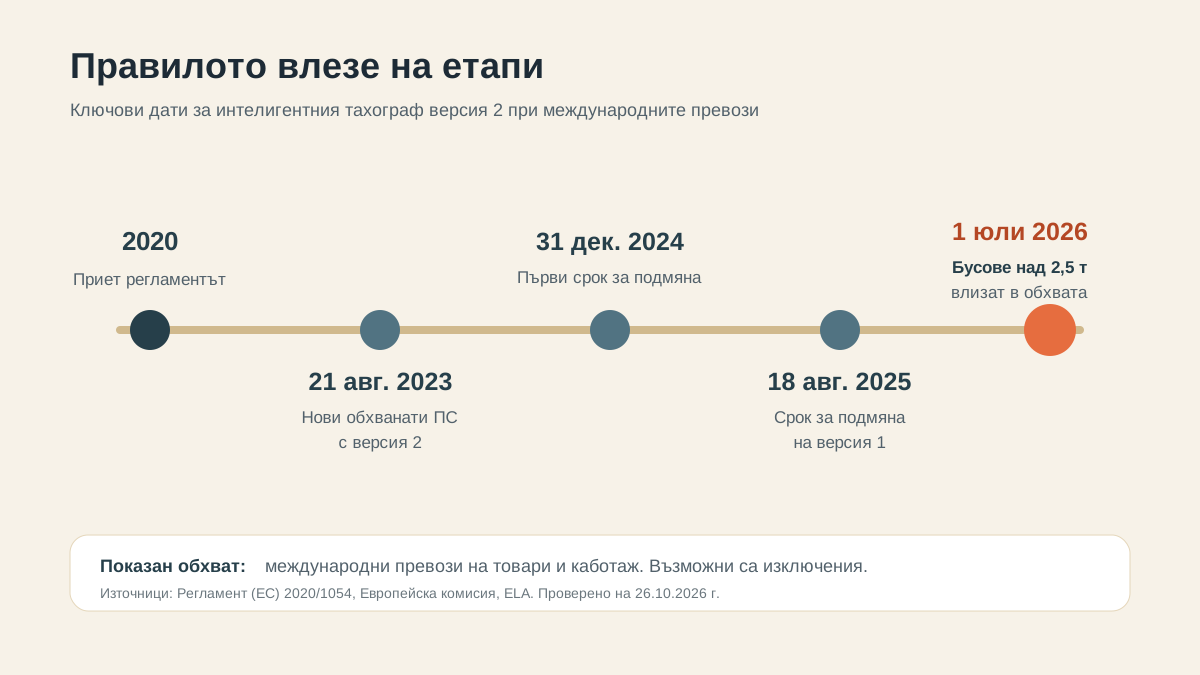
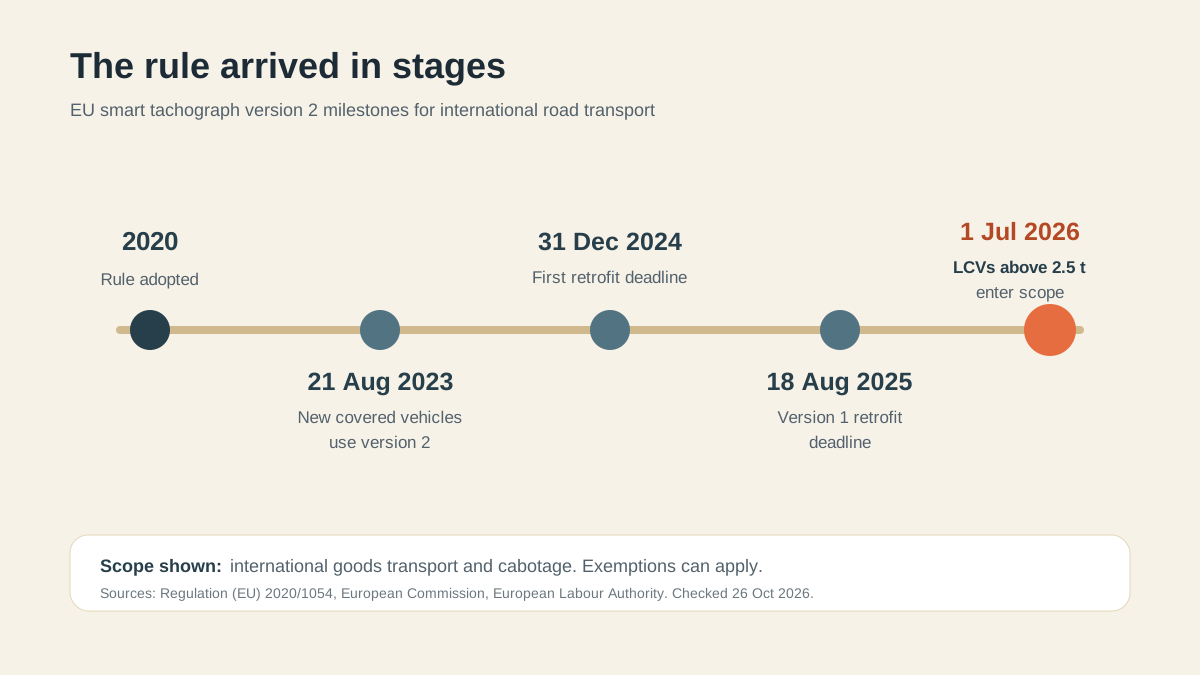
The 2026 date completed a staged rollout. The regulation was adopted in 2020. New covered vehicles moved to smart tachograph version 2 in August 2023. International heavy-vehicle retrofit deadlines followed in December 2024 and August 2025. Light commercial vehicles entered the stated scope on 1 July 2026.
The 4.5-hour line changes route economics
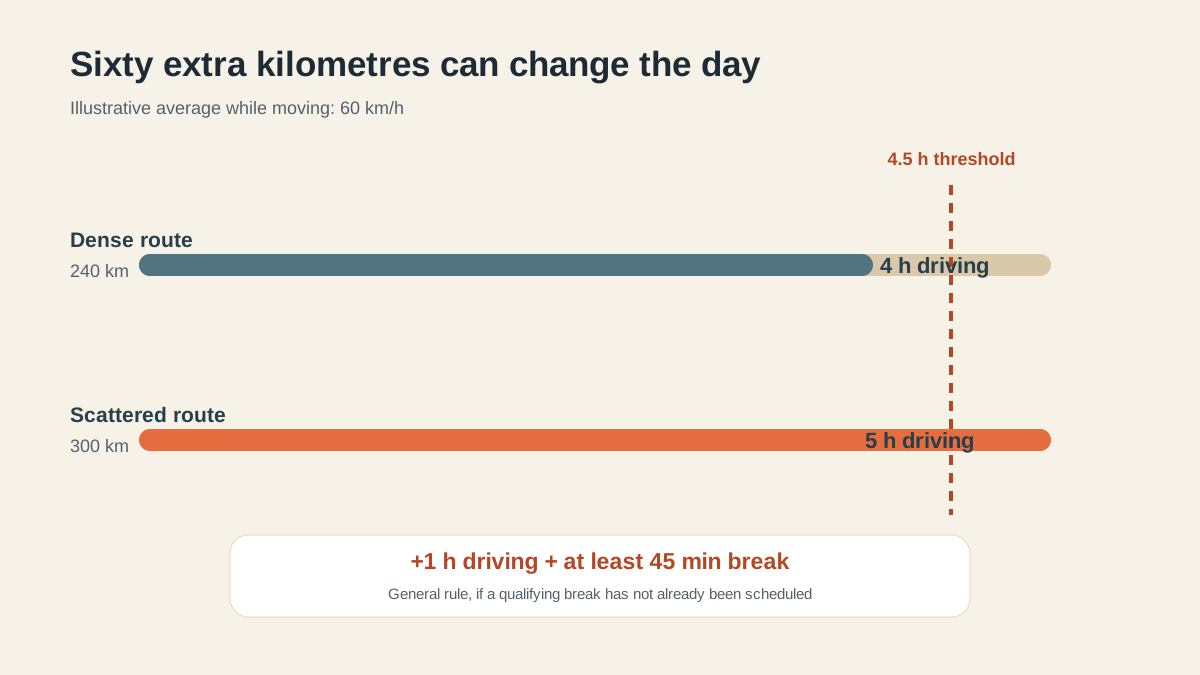
ELA summarises the general limit as nine hours of daily driving, extendable to ten hours twice in a week. After 4.5 hours of driving, the driver must take at least 45 minutes of break. The break can be split into at least 15 minutes followed by at least 30 minutes.
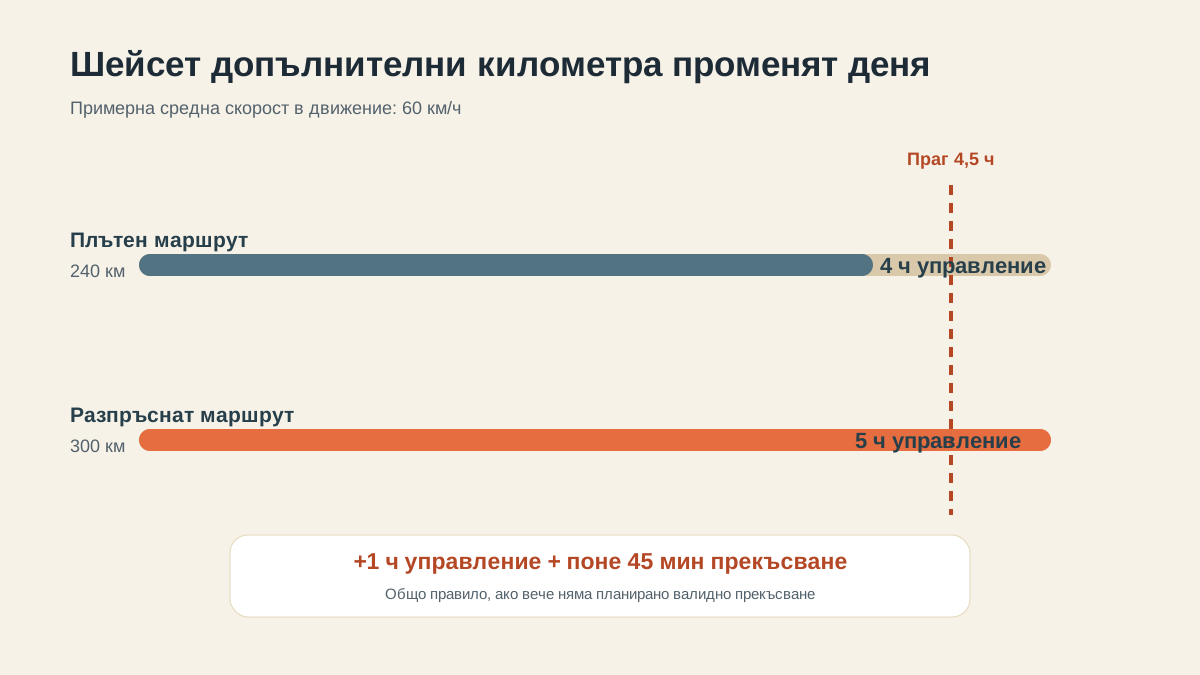
Consider two illustrative routes serving the same eight completed deliveries. At an average 60 km/h while moving, 240 km uses four driving hours. A scattered 300 km plan uses five. The second plan adds 60 km, one driving hour and crosses the 4.5-hour threshold.
Loading, unloading and paperwork count as work in many circumstances, so they should not be assumed to satisfy the break. The real schedule depends on the complete record of driving, other work, availability, breaks and rest.
One extra kilometre costs €0.188 in diesel today
The European Commission's bulletin published on 22 October reports tax-inclusive Bulgarian automotive diesel at €1.8837 per litre for the 19 October observation. With an illustrative van consumption of 10.0 l/100 km:
fuel per km = 10.0 ÷ 100 × €1.8837 = €0.18837
The denser 240 km route uses €45.21 of diesel in the same model. That €11.30 difference is a direct fuel saving only when the shorter plan completes the same work. Tachograph equipment, labour, tyres, maintenance, depreciation, tolls, parking and administration remain outside the figure.
Twelve compatible deliveries cut fuel per stop by one third
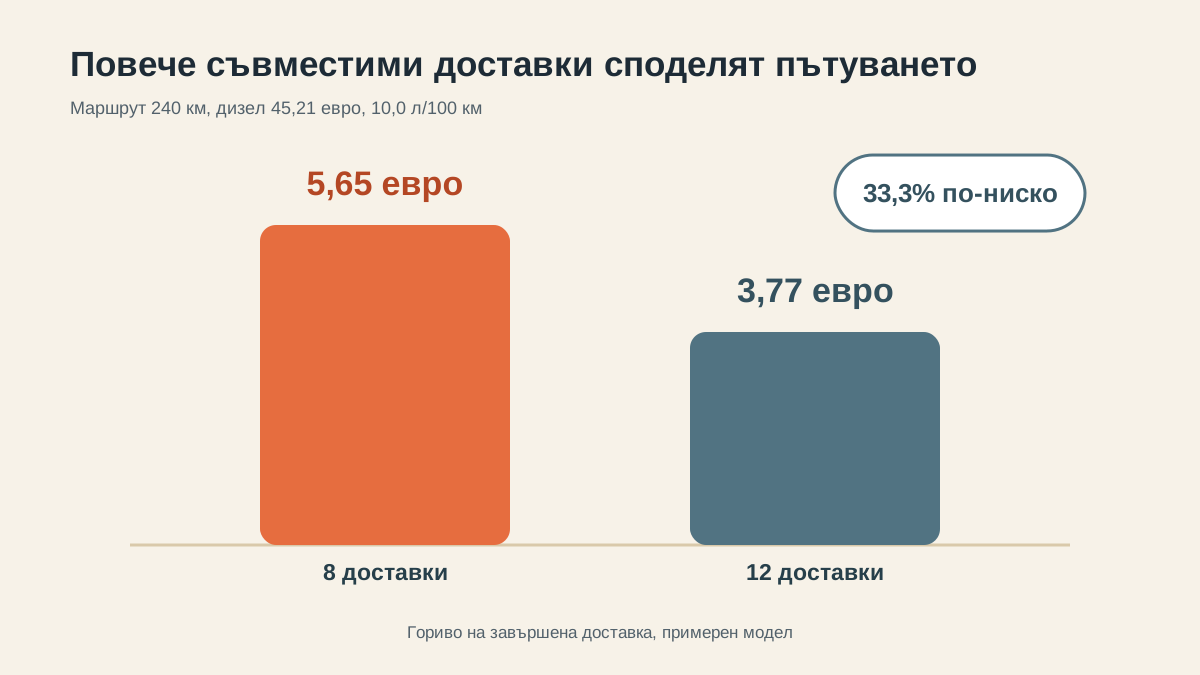
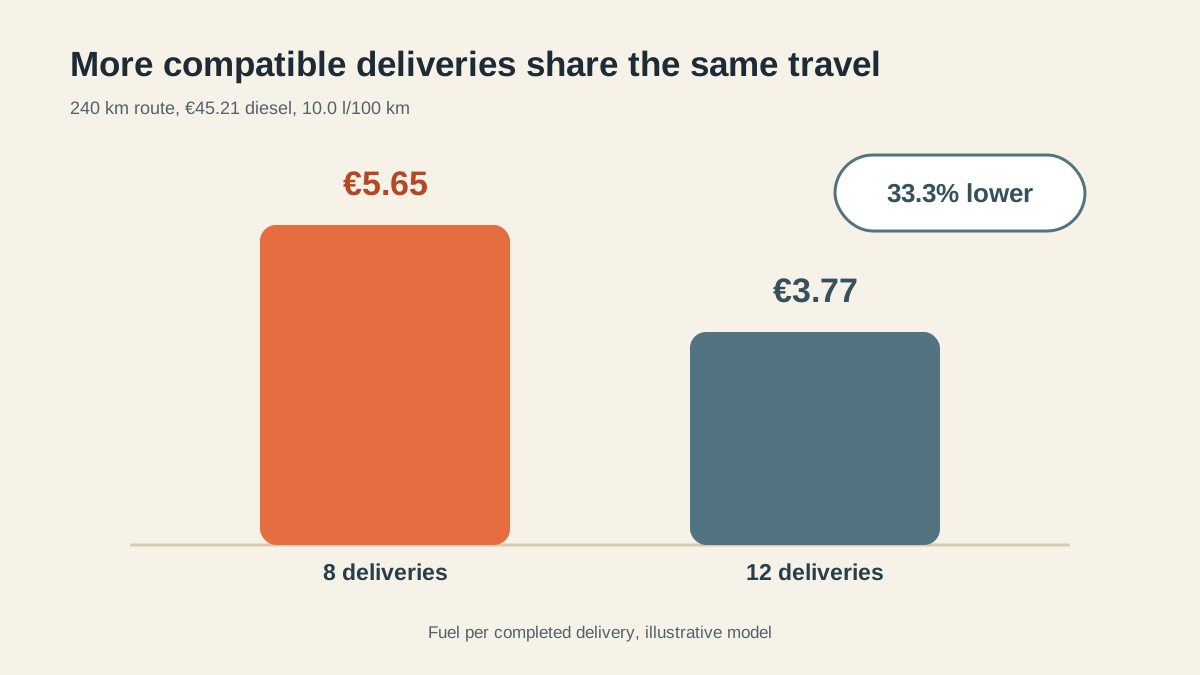
The 240 km route costs €45.21 in diesel. With eight completed deliveries, fuel is €5.65 each. If four additional deliveries fit the same corridor with no extra driving distance, twelve completions share the bill and fuel falls to €3.77 each, a 33.3% reduction.
The extra stops still use handling and service time. They can also affect working-time and rest obligations. Route density improves unit economics when the deliveries fit the same compliant trip and the company measures the full day.
What a small owner should check before dispatch
- Classify the vehicle combination. Record maximum permissible mass for the van and any trailer.
- Classify the work. Separate domestic, bilateral, cross-trade and cabotage operations, then check hire-or-reward and own-account conditions.
- Build a driving-time budget. Put accumulated driving, planned breaks, other work and rest into the dispatch sheet.
- Price every kilometre. Use the diesel price actually paid and measured vehicle consumption.
- Group compatible deliveries. Add stops along the corridor when capacity, promised time and handling remain workable.
- Review the plan with the driver. Road delays, border queues and safe parking can move the real day beyond the plan.
Where MileCut fits
MileCut imports an Excel or CSV address list, allocates stops across one to five couriers and shows the proposed order and planned distance on a map. Team and Control users can move stops between couriers and reorder them before creating separate Google Maps links.
For a cross-border operation, use that review to expose a scattered stop before it adds kilometres to an in-scope driving day. Keep tachograph classification, legal records, break planning, border time and driver compliance in the company's transport process.
MileCut currently covers address import, route allocation, map review, manual stop changes and navigation handoff. It does not calculate statutory driving hours, read tachograph data, classify transport operations or certify compliance.
Sources and limits: Regulation (EU) 2020/1054, European Labour Authority light commercial vehicle guide, ELA driving and resting time leaflet, Bulgarian Road Transport Administration notice, European Commission tachograph overview, European Commission Weekly Oil Bulletin. Sources were checked on 26 October 2026. This is general operational information. Confirm the rules for your vehicle and activity. The distances, speed, consumption and delivery counts are illustrative. Use company records for decisions. External rules and averages do not establish MileCut savings.
Protect the driving-time budget before the van leaves.
Upload the address list, keep compatible stops together and review planned distance for every courier.