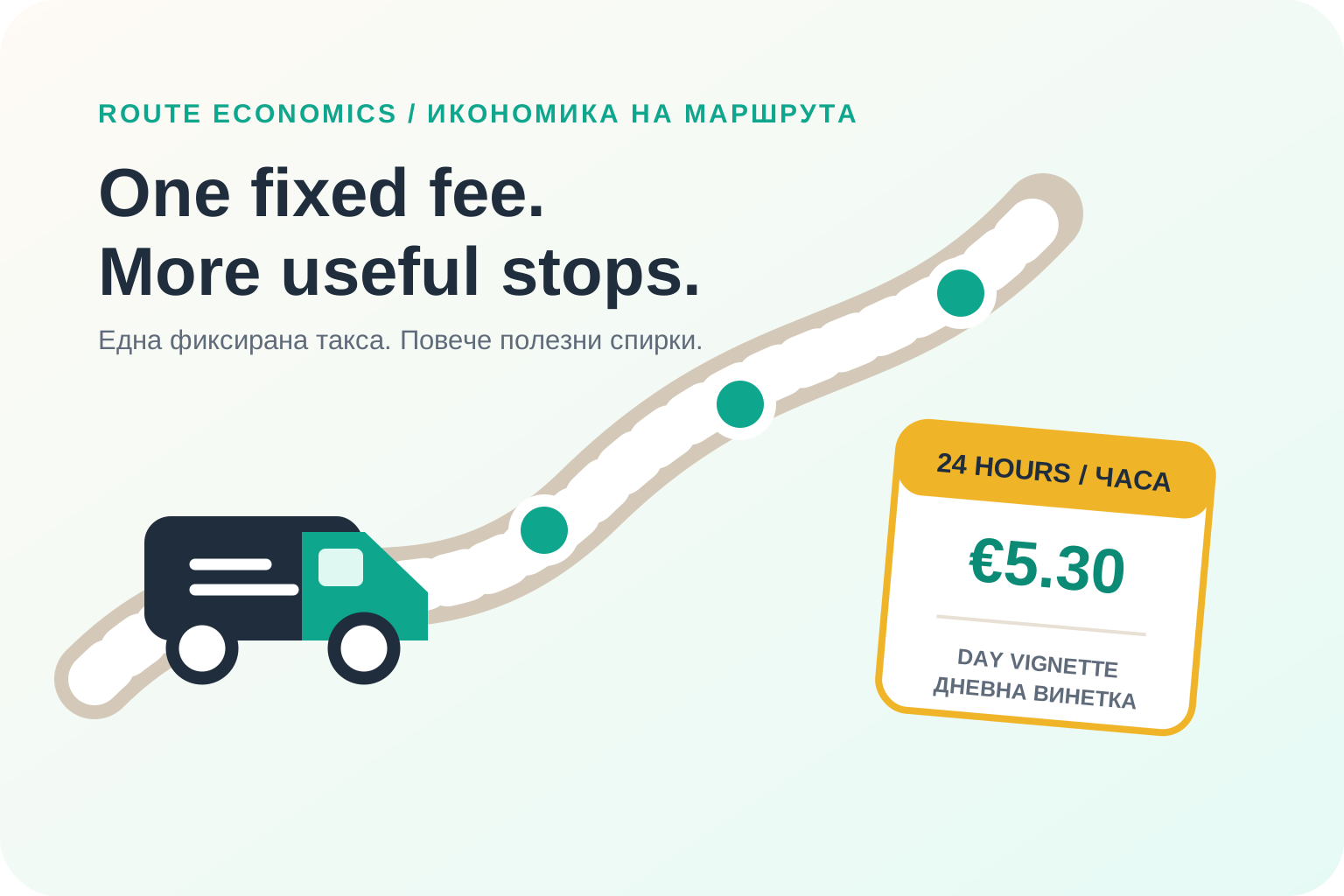
Bulgaria's one-day e-vignette now costs €5.30. For a small delivery company, that number becomes interesting when a lawful route on the paid network replaces a longer lawful route outside it.
At the latest European Commission diesel benchmark for Bulgaria, a van using 10 litres per 100 kilometres burns €5.40 across 28 added kilometres. Direct diesel alone has crossed the one-day fee. Driver time and vehicle wear make the longer route more expensive still.
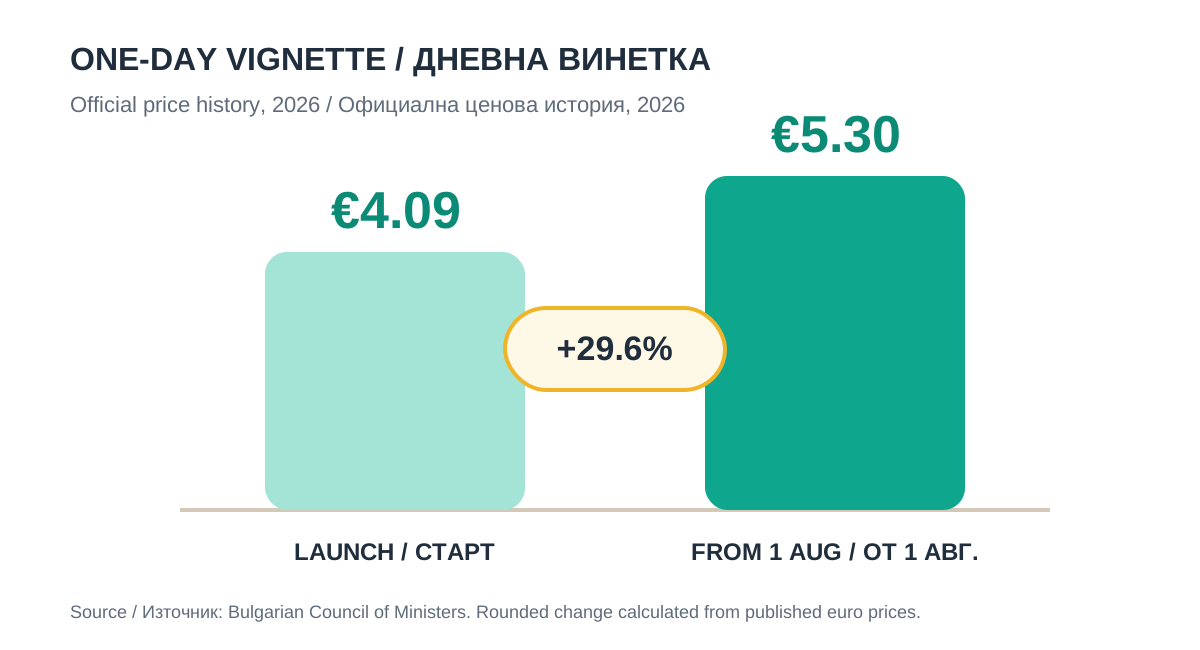
The fee rose 29.6% in August
The one-day vignette launched at €4.09. The Bulgarian government approved a 30% tariff increase from 1 August 2026, taking the published price to €5.30. The increase calculated from the two rounded euro prices is 29.6%.
BG Toll's live purchase page confirms the current €5.30 fee. The validity period is 24 hours from the selected starting date and time. The product covers eligible vehicles up to or equal to 3.5 tonnes. A trailer may require an additional vignette when the combined technically permissible mass exceeds 3.5 tonnes.
| Current product | Official price |
|---|---|
| One day | €5.30 |
| Weekend | €6.60 |
| Week | €10.00 |
| Month | €19.90 |
| Quarter | €35.90 |
| Year | €64.50 |
The cheapest product for one dispatch plan depends on the real operating window. Two separate one-day purchases already total €10.60, above the weekly fee. Validity definitions differ, so compare the exact dates and times of the planned work before buying.
The fuel-only break-even is 27.5 kilometres
The European Commission workbook available on 2 October reports Bulgarian automotive diesel at €1.9277 per litre for 28 September 2026. For an illustrative van using 10 l/100 km:
direct fuel cost per km = €1.9277 × 10 ÷ 100 = €0.19277
fee break-even = €5.30 ÷ €0.19277/km = 27.49 km
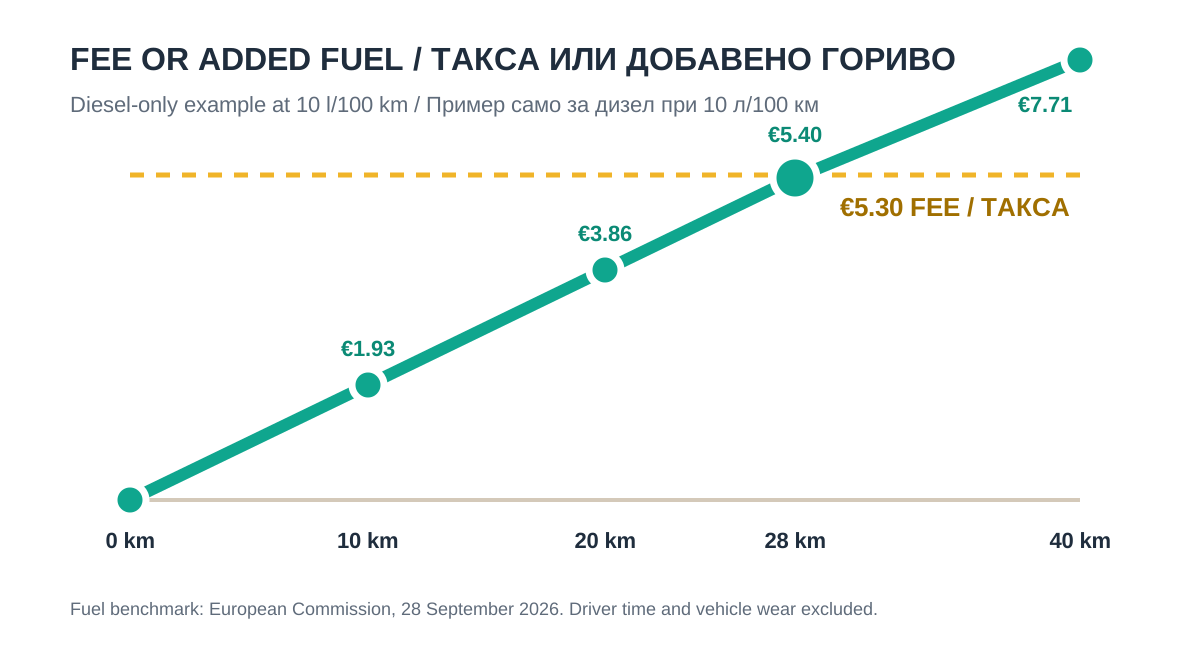
Consider two legal options for the same stops. The untolled route adds 31 km. At the stated consumption and fuel price, those kilometres cost €5.98 in diesel. The one-day fee is €0.68 lower, even before paid driver time, tyres, servicing and depreciation enter the calculation.
A 20 km difference points the other way on fuel alone: €3.86 of diesel is below the €5.30 fee. Time, traffic and vehicle cost may change the full result. The useful decision compares the complete plans for the same successful deliveries.
A fixed fee becomes smaller when the route carries more work
The fee is attached to the vehicle and validity period. That makes route density operationally important. Spread €5.30 across four completed deliveries and the fee is €1.33 per delivery. Across sixteen it is €0.33, a 75% reduction in the fee per stop.
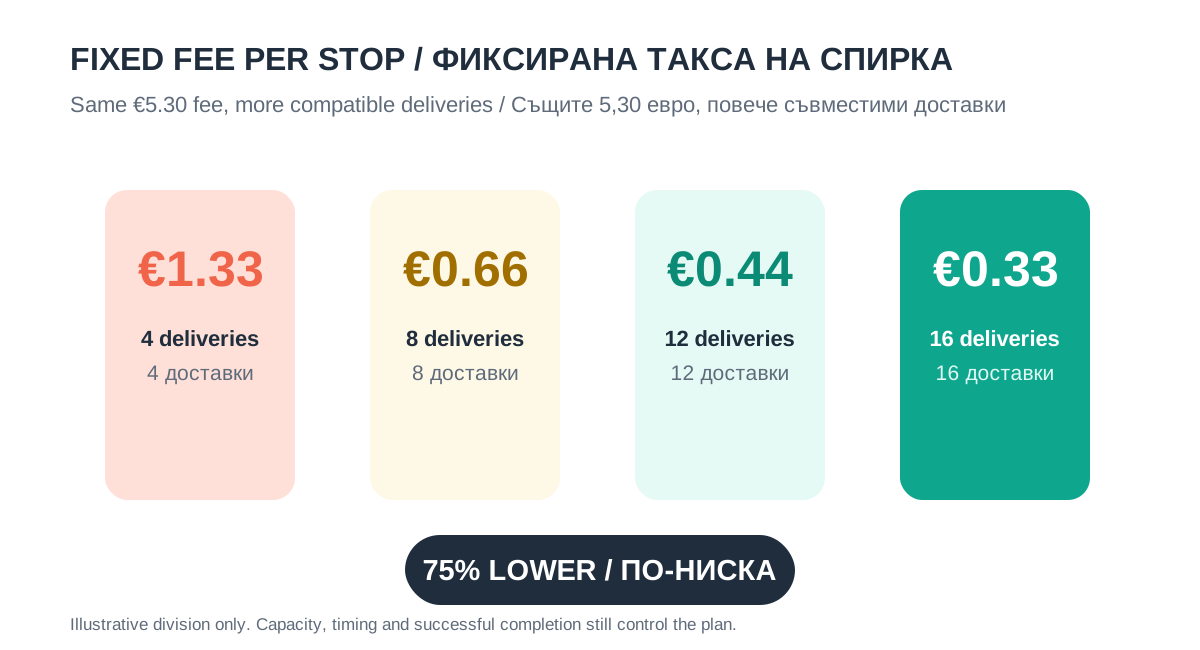
More stops are valuable only when the route remains feasible. A dense plan that overloads the van, misses time windows or creates failed deliveries destroys the apparent saving. Capacity, service promises, loading order and driver hours still control the plan.
Build the decision around the whole delivery day
- Mark the work that may use the paid network. Identify the relevant addresses, access corridors and operating times. Confirm the official road map and the vehicle's eligibility.
- Group compatible deliveries. Bring nearby stops with compatible time windows, capacity needs and service requirements into the same candidate route.
- Compare total planned kilometres. Record the full distance for each lawful option, including the return to base. Multiply the distance difference by your own fuel cost per kilometre.
- Add the remaining direct costs. Include the vignette, paid driver time and the company's variable vehicle cost. Use actual completed deliveries when calculating cost per stop.
MileCut helps with the planning comparison. Upload the day's stops, review their allocation and sequence, compare the total planned distance, then share the chosen routes through Google Maps. Keep vignette validity and eligibility beside the plan because MileCut does not determine road-fee liability or purchase a vignette.
The management habit is simple: measure the fee, the kilometres and the completed deliveries together. Fewer excessive kilometres lower the direct operating bill. More compatible deliveries on one feasible route spread the fixed access cost across useful work.
Sources and limits: BG Toll live one-day vignette page, Ministry of Regional Development on 24-hour validity, Council of Ministers on the August 2026 fees, European Commission Weekly Oil Bulletin. Calculations use a national average, 10 l/100 km and rounded euro values. Actual routes, prices and consumption vary. No fixed saving is promised.
Compare the whole route before paying for extra kilometres.
Group compatible stops, check total planned distance and spread fixed access costs across completed work.